Author Archives: Alissa

Talkin’ ’bout My Generation (and Why We’re So Pissed Off)

Hi. I’m back. Suffice it to say, most of the month of November, as well as December, have continued to be just as craptacular as the day mentioned in my last post. However, I know very few people who have not been having at least some struggles lately. Everybody seems to have their something right now. I guess that I’ve been busy grieving for the probability of the life I had dreamed of. My personal process has followed the Kubler-Ross model to a T. I think I’m somewhere between the anger phase and the acceptance phase. Can I invent a new phase called the therapeutic Internet ranting/armchair philosophy phase?

Disclaimer: I make a lot of generalizations in this post, but they are based on some sociological theories on generations. Furthermore, this post is mainly about general observations of and difficulties experienced by my generation, and does not mean to discuss, or to particularly exclude, others.

 I was born in 1979, on the tail end of Generation X.  My parents were on the tail end of the baby-boomers, born in 1957 & 1958. Personally I feel that means that I was raised to expect a shit-storm: don’t trust authority, ask questions, think for yourself, but also have a lot of hope (If you follow the right steps, you’ll make it just fine).  Unfortunately, it seems like those of us that are on the cusp of Gen X and Gen Y inherited the perceptions and values of the Xers, and the economic situation of the Yers. Like a lot of my peers on the cusp of the 2 generations, I grew up feeling well cared-for and well-loved. However, unlike a lot of the later Gen Y, I did not grow up thinking that I was a special snowflake. I did not grow up thinking that the world owed me something. I certainly didn’t grow up thinking or expecting that my parents would take care of me beyond high school. I did grow up understanding that I had to earn the things that I got. And if I earned them, I deserved them. And if I didn’t earn them, I didn’t deserve them (ahem, latter Gen Y).

What seems to have happened in recent years is that there are a whole lot of people out there that, based on the old model of our society, the baby-boomer model, have earned a certain lifestyle.  They have made the investments. They have done the work. But now, rather than getting the big pay-off they get…nothing. They get over half a lifetime of indentured servitude, unhappy with underutilized skills and intelligence, making wages far lower than they should be; mainly to pay on student or housing loans that were touted as bullet-proof investments, not being able to go anywhere, not being able to do anything or buy anything. Here’s what you get for trusting authority, kids.

From out of this group of late Gen Xers and early Gen Yers comes things like the Occupy movement. We did what we were supposed to, and it didn’t pan out. In fact, our lives are worse than they would have been if we hadn’t been suckered into expensive educations or a little suburban jail cell of our very own. Now the corporations and the government have the gall to turn around and tell us it’s our fault. We’re stupid because we made the decisions that we were pushed to make. And now the economy is supposedly failing because we’re not spending. NEWSFLASH: WE DON’T HAVE ANY MONEY, geniuses!!! The earlier of us because we took student loans that weren’t supposed to be a gamble and now have jobs that don’t cover our bills (moi and a lot of my compatriots), and the later of us because we (even more screwed!) have student loans (because apparently you now need a degree to work at Barnes & Noble!) and can’t get jobs at all. And, frankly, we’re pissed. We’re grieving the lives we hoped for and didn’t get. We don’t know what to do with our rage. So we go out and march on the streets before we have really well-defined what it is we’re demanding.

All that being said, I didn’t participate in Occupy. I definitely feel the Occupy movement. However, I’m generally snobbish towards people who don’t plan, at least a little, before acting. Because they didn’t have a cohesive manifesto or action plan, the whole movement came across to the powers-that-be, and to the rest of the baby-boomers, as nothing more than a concerted temper-tantrum. Furthermore, we are in the middle of a big ol’ pile of poo right now. Seriously? The government is going to forgive all these ruinous student debts at the same time? Do you know how much money that is? You do know that the government is already in debt, right?  I don’t actually blame the Occupiers that much for their lack of cohesive thought, though. Our country is in such a mess, such a tangled web of issues right now, that it’s hard to separate them out and look hard at any given problem. There has been a long history during which things got f’d up. We’re not going to work it all out in a month.

Tomorrow: my thoughts on what, I feel, is a more rational and outcomes-based approach to protest, and its relationship to generational mind-sets.
Chaos Backstory: My Sordid Food History

In my recent ramblings here I’ve been focusing a lot on how I’ve finally been having some breakthroughs on some health-related issues (read: addictions); namely food, booze, and cigarettes. I’ve mentioned on numerous occasions here that I’ve had life-long eating disorders (ED), and have said that those are the root addiction for the other two. However, I don’t think I’ve ever really told my story here. In fact, the only person who really knows and understands the whole story at this point is my husband.

After spending a lot of intensive time thinking about my sordid past in the last six months, I feel like I’ve sorted through a lot of things (particularly some of the anger that I have surrounding my ED), and am ready to share it. I think that the backstory helps to give some context to what I’ve been struggling to pull myself out of for the last several years, and helps me to frame up some of where I want to go with my writing here in the future.

So, I guess the first point of clarification is that I refer to my history of food issues generally as “eating disorders” because I don’t feel like any of the three major “diseases” really accurately describes me. The three generally acknowledged eating disorders are anorexia nervosa, bulimia nervosa, and binge eating disorder. From what I understand, a lot of ED sufferers don’t feel that they fit squarely into any of the three categories.  This is probably because the three have overlapping symptoms and hypothetical causes (there is no agreed-upon cause for ED), so a lot of people really do express all three throughout their lives.

My ED began as a pretty young child with straight-up binge eating, which is the least commonly diagnosed and, I feel, the ED that is taken the least seriously (which is very unfortunate because I would guess that a lot of the incidents of the other 2 EDs started out with binge eating, and all 3 disorders have negative long-term health effects). During my fairly brief stint in treatment for my eating issues, I was diagnosed with Bulimia. What that meant for me was that I would starve for 2 or 3weeks, and would then kind of “lose my mind” and go on a binge-purge spree for 2 or 3 days. Once I was “cured” of Bulimia, I stayed pretty stable and healthy for about 2 ½ years, and then slowly began sliding back into binge eating.

To keep any one part from getting too long, over the next week or so I’m going to break the whole story down into 3 parts: childhood, college, and adulthood.

Sorting through all this crud has been a 10-year work in progress of varying intensities, and I’m sure I’m not totally through it all yet. But I do feel like I am well on my way, and have a much better awareness surrounding it than I ever have before. For that I am grateful!

Just Start

It’s beginning to be very clear that I started a progression in May when I began trying to take off the excessive weight I had gained. I guess that somewhere in me I knew that if I just started to reach for one piece of one goal (good health) and actually stuck with it for awhile, believed in it, that the path to the others would naturally unfold in front of me.  I just needed to have a little help and a little faith that it wouldn’t be as hard as it seemed. I mean, people get over heroin addictions, right? Or Meth.  Or alcoholism. Or smoking cigs for 33 years (seriously, if my mom can quit smoking after that long, I should be able to, right?!).

It has been amazing how one piece of one goal leads to another piece. When I haven’t been trying to do everything all at once, and have just been focusing on one thing at a time, it has been so much easier to move right from one thing to another. I started with weight-loss and food issues because that is the hardest and most long-term health issue I’ve had. I have had an eating disorder of one kind or another for my entire life.

After five months of having my eating issues under control, the decision to quit drinking came very naturally to me. I didn’t need to force it because I had learned through dealing with my eating issues that alcohol is escapism for me. It was also a major contributor to the weight gain, and a major detractor from spending my time in a meaningful manner. Alcohol was a much more minor addiction for me than food. In fact, I think that alcohol itself isn’t an addiction for me at all; it is a secondary addiction (which I’ll go deeper into in a later post).

After six months of having my eating issues under control, and three weeks of being a non-drinker, continuing to smoke cigarettes was just seeming silly. There was nothing really satisfying about it anymore. It was just putting a dimmer on my other accomplishments.  By all accounts my body should have been feeling a lot better minus the bad eating habits and the drinking. But I still felt like crap thanks to smoking: swollen sinuses, shortness of breath, fatigue, etc.  I realized that I was only continuing to do it out of fear. If I was able to stop using food like a drug, and to stop drinking as escapism, what was I scared of? I know I can do this. I am doing it.

It is true that elements of all the health changes I’ve made have been difficult (I plan to write about some of my challenges, learnings, and experiences here over the next week or so). But they haven’t been nearly as bad as I made them in my mind during the years (years! Sad.) when I had so much trouble just getting started. The surprising part is that the gains from making one change have been so exponential. Once you start to feel good again (or, maybe even for the first time!), you actually want to do more stuff that will make you feel better – even if it’s stuff that seemed impossible before. Weird, right?

I know this sounds so cliché. It sounded that way to me for a long time. But seriously: just start. It does get easy eventually!

Perhaps I was a Bit Slow to Admit I Needed Help

Six weeks ago I made a decision about my weight issues. I decided that I had been trying various methods of dieting for 2 years, and nothing had really worked, so maybe it was time that I swallowed my pride and got some help. A couple of my co-workers have been on Weight Watchers for a long time, and both of them have really liked it, so I decided to give it a shot. However, the whole idea of attending meetings and weighing in under supervision really freaked me out. All I could picture was a weekly recreation of humiliating childhood experiences in locker rooms. Now, I know that’s irrational, but it’s a fear nonetheless. So I decided to use the Weight Watchers online program to start, and if that didn’t work, then maybe I would try the meetings.

What I have discovered (rediscovered?) in the first 6 weeks is that there really is no magic bullet for me. Yes, my metabolism could be more sluggish than that of others. Yes, I can’t eat as much as the average person can because I’m petite. Yeah, my body doesn’t process sugar very well. Yes, many of the excuses that I have used for giving up in the past could possibly be true. But none of those excuses will ever change the fact that my body is what it is and it only needs a certain amount of food per day. I can think it’s not fair all I want, and it’s never going to change the fact: I’ve been consuming too many calories for my body to use.  So I can either suck it up and stop being whiny and excessive or I can learn to accept being overweight and uncomfortable.

I choose “suck it up.” I am very interested in being healthy, and in being able to enjoy life to the fullest. I am still working on the whole issue of image v. self (ie., how much of my wellbeing is truly determined by  my own and other people’s perception of my appearance?), but I would like to feel good about my appearance. Regardless of who’s deciding the definition of beauty, I think that healthy is beautiful.The straight up fact is that I haven’t been very healthy, and I don’t look it. At the age of 31 I am already being physically limited by problems caused by being overweight: my neck, back, and knees have been suffering.

Anyhoodle, so far the WW online program has been working for me.  I like that no food is off limits. I can stick to eating traditional foods and not using low  fat or other processed food (if I don’t wanna!) without a problem. I have clearly been having a problem with estimating portions on my own, so I also like the point system that WW uses because it makes keeping track of portions a lot easier than trying to count calories, fat grams, or carbs. Each week I also get “activity points” for any exercising I do. That means that I get to eat more as I work out more. I haven’t even been using all my activity points, but something about them really drives home that “treating myself” is a trade-off. The added incentive means I’ve been working out for a minimum of an hour 5 days/week (rollerblading, biking, hiking, or jogging with the dog).

I’ve lost 10 lbs since joining, plus 5 I’d already lost earlier in the spring. 15 lbs is a lot of bulk off from a short person! My knee problems are already almost gone. I have voluntarily been eating more fruits and vegetables. I still have a long way to go, but I am already feeling a lot better, which is the greatest possible incentive.
 

In Which I Think I Have an “Aha” Moment

I have a fairly long habit of reading a small meditational passage of some sort right before I go to sleep at night. It gives me something good to think about so I don’t get into the anxious headspace that causes insomnia for me. I try to be somewhat diverse in my choices. Some frequently used sources have been:

  • The Tao of Pooh
  • The Te of Piglet
  • The Tao Te Ching
  • The Bible
  • The Bhaghavad Gita
  • The Third Jesus
  • The Little Book of Zen
  • The Mastery of Love

I have been into The Way to Love by Anthony de Mello lately. He’s another one of these East/West fusion guys that I tend to like. One of his meditations that I read recently has really struck a deep chord with me. It is based on the Bible verse, Matthew 6:3: “When you give alms, do not let your left hand know what your right is doing.”

The particular verse is specific to giving, but de Mello branches it out into the idea of happiness, or holiness, in general. He points out that “the moment you are aware of your holiness, it goes sour and becomes self-righteousness.”  Similarly, he argues that true happiness is uncaused. It is a state of being, not a string of events or a constant state of excitement over events.  

According to de Mello, true holiness and true happiness are unselfconscious, effortless, and without ambition. We don’t achieve these states of being through effort or discipline. Strong effort to be happy or holy (ie. “admirable”)often signifies that your ego is pushing you into making efforts to become something you’re not meant to be so it can glorify itself. He writes that:

effort can change behavior, it cannot change you. ..it can put food in your mouth, it cannot produce an appetite; it can keep you in bed, it cannot produce sleep… it can force you to pay a compliment, it cannot produce genuine admiration.

He contends that a person can’t strive for happiness because “if you desire happiness you will be anxious lest you do not attain it. You will be constantly in a state of dissatisfaction; and dissatisfaction and anxiety kill the very happiness that they set out to gain.”In de Mello’s opinion, the only way to find sustained happiness is to remove the things that make you unhappy or unfulfilled; in other words, your attachments.

This passage struck a chord with me because of the enormous amount of struggle I’ve been going through trying, as I so succinctly put it yesterday, to “get my shit together.” I beat the crap out of myself all the time, basically about how not-admirable I am.  However, I do happen to agree with de Mello that the only way to find happiness is to get rid of the things that make you unhappy; not to strive towards things that you think will make you happy.

So, this points out a philosophical problem in my approach to this blog. I have been writing it based on achievement, or lack thereof. Really my approach should be writing about the journey of getting over my attachments; for example, my attachment to having a place of perceived success in a socio-political-economic structure that I don’t even believe in. Or, my attachment to being attractive in a way that is set in place by a media that is largely based on making money by preying off from people’s psychological  weaknesses.  Etcetera.

The other conundrum that I’ve been rolling around in my mind has been: if I’m not writing this blog for my ego, or to goad myself into striving to “win,” why am I doing it? The answer is because I love to write. I love to set down and share experiences. I could use support and feedback. I’m human and I don’t want to live in a void. Is that a good enough answer? = )

Humility

My Lunch Today

Lately I’ve been in the middle of one of my big “what does it all mean? Why am I doing this?” things. It’s a pretty safe bet that any time I take a long hiatus from blogging, that’s what I’m doing. I’m rethinking.  I’m waxing philosophical. I’m searching for purpose. Trying to find meaning.

Really, I’m doubting.

Or, I’m actually really, really busy in my personal life, and I’m just not making time to observe or to write. But usually not making time is just an expression of the doubting.  I have, once again, been doubting my ability to remain really honest in “public,” and questioning the reasons behind writing a blog.  I’m still terrified of being judged (based on anything I care about, anyhow. I’ll shamelessly make an ass out of myself any day!). The whole original point of this blog was to subject myself to public humiliation as a way to strong-arm myself into getting my shit together. Clearly that’s not going to work if whenever I’m being “bad” I either:

  1. Misrepresent what’s happening by writing exclusively about the positive things I’m doing, or
  2. Don’t write anything at all.

I know that I’ve resolved before to just be honest about being bad, and that being bad really isn’t as bad as I think it is from my twisted perfectionist/control freak point of view (I know – you probably wouldn’t know that I’m a perfectionist of any sort unless you knew me REALLY well!). Then I have broken that resolution. The truth is that I have trouble taking my ego out of this. I have trouble failing over and over in front of anyone who might be reading. I have trouble trying to stop myself from believing that people will only be interested if I’m successful at what I set out to do. Even though I know, intellectually, that’s completely irrelevant because NOBODY CARES.

AND THEN, after I’m done beating myself up for being afraid of what people might think of what a screw up I am, I go ahead and beat myself up for attention-whoring via trying to convince others that I’m more wonderful than I am. *sigh* So many layers to the onion.

Anyhow, point being, please excuse my neurosis of the past few months. And, also in the future. Since I don’t plan on hiring a shrink or a guru any time soon, I will continue to demand patience as I work through my catalog of personal issues. Some of which I will publish, some of which I will keep to myself (for your sake and mine).

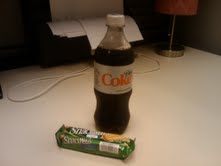
In the meantime, I will try to be honest about how much I still smoke (yes, it’s true! In an on-and-off sort of way), how much processed food I still eat (see above photo), how broke I am (VERY), etc. And, also, my thoughts and most recent justifications for all of the above! But mostly I will do whatever I need to do to just keep writing! = )

Of Food and Freedom

A new state bill is up concerning raw milk sales. I first heard about this via MPR, so I went to the MPR website to find out more. Here is MPR’s coverage of the issue. But first I have to point out that when I searched “food law” and sorted by date, this gem of a news blip came up: Freedom to Eat.

The fact that these two articles (and proposed laws!) are so close together strikes me as kind of hilarious. The raw milk coverage heavily leans against having freedom to choose your own health risks, and the freedom to eat article is about a bill that proposes personal responsibility for obesity.  I just want to point out that the MPR article attributes to raw milk approximately 1,700 illnesses and 2 deaths(nationwide, according to the Center for Disease Control (CDC)) between 1998 and 2008 (that is, for the record, 10 years). Even if this statistic is accurate, it doesn’t seem like that big of a deal when compared with the full scope of foodborne illnesses (quoted from the CDC’s 2002 report on Foodborne Illnesses, bolding is mine): Foodborne diseases cause an estimated 76 million illnesses and 5,000 deaths in the United States each year. The 2006 (the most recent full survey that I could find on the CDC site) report doesn’t even include dairy in the top offenders: the most common food commodities to which outbreak-related cases were attributed were poultry (21%), leafy vegetables (17%), and fruits/nuts (16%).

Now for the other article. How many illnesses and deaths are attributed to obesity?  Well, I couldn’t find a direct statistic (probably because obesity is related to so many different illnesses, it’s hard to nail down an exact number), but here’s the CDC’s most recent obesity report, and here’s how much obesity costs in this country. Funny that this obesity problem showed up in the U.S. right around that time that there was widespread food processing. Funny that milk pasteurization didn’t start until around the turn of the century, with the appearance of industrial feed lots, but is now  a must for all dairy farmers, big or small.  But, I digress…

I’m not going to go into some drawn out argument on why I think raw milk is good. I believe that the details of the raw milk argument are more or less beside the point. The point is personal liberty. People should have the right to choose what they purchase and eat. If the government wants to hold us responsible for choosing to eat foods that are known to make us obese (or cigarettes, or booze for that matter!), why shouldn’t we be granted the responsibility (AKA, freedom!) to choose foods that may carry some risk, but definitely carry some benefits (and, based on the info above, we legally choose foods that carry risk, anyhow!)? Why should the government regulate some choices, but not others? Think about it. It just doesn’t make any sense.

Love for “Animal, Vegetable, Miracle”

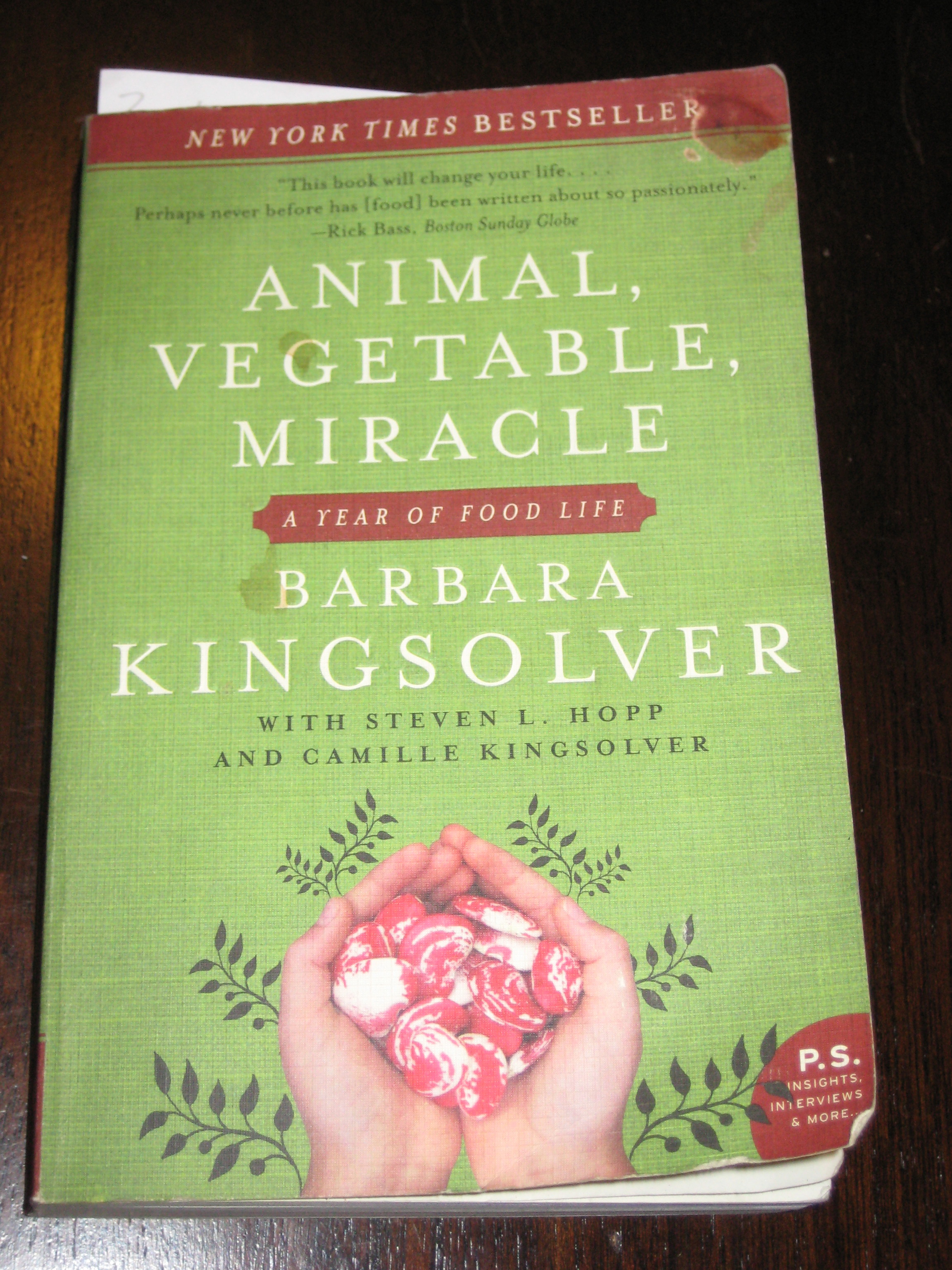
My copy. Note the food stains on the cover.

I’ve owned a copy of Animal, Vegetable, Miracle for over a year. Barbara Kingsolver has been one of my favorite authors ever since I read the The Bean Trees in high school. I think that she’s a phenomenal writer, and I’ve been a fan of her focus on environmental preservation for a long time. So you’d  think, especially as a whole-foods freak, that I’d have been totally stoked to read about her year of eating only local and homegrown foods book. I was stoked when I bought it, but then I had a few false starts. I just couldn’t get into it.

At first I thought that it was boredom. A lot of the facts and opinions that Kingsolver &  family present are the same as those presented in other books I’ve read, such as Omnivore’s Dilemma, In Defense of Food, and Plenty. But, considering that the book is still slightly different, and entertaining due to Kingsolver’s wit, boredom didn’t seem to be enough of an answer. After struggling to get into the book for several month; the answer dawned on me. I was jealous! Basically, Kingsolver is living MY ideal life! She’s a highly successful professional writer, she has what seems like a great family, and she is living my rural dream: growing her own food, having time to cook, and having peace and quiet and nature all around her.

Once I realized that I was just jealous, I was able to get over it and enjoy the book, wherein Kingsolver and her family move away from Arizona and on to their family farm in Virginia. They commit to a full year of eating foods that they have either grown themselves or sourced locally. The book is full of gardening, cooking, and animal-raising anecdotes  from Kingsolver, as well as recipes and essays on their experience from her 18-year-old daughter, Camille, and more scientific essays on the global impacts of the standard  American diet from her husband, Steven Hopp.

True to form, Kingsolver’s writing style is wonderful. She is descriptive, yet still conversational. Her passion for delicious food is contagious. Unlike Plenty, this book has nothing to do with deprivation. It is all about how much more flavor and abundance one’s life can have by eating food that is grown close to home. It’s not just about tastes, it’s also about living in the moment and taking full pleasure in what nature has to offer. It is an absolutely compelling argument (for pretty much anything) to explain all the ways in which a person’s experience of life will be better if they choose a particular lifestyle. Kingsolver is able to advocate local eating by example and without proselytizing.

Despite my desire to run away to my family’s farm and live precisely as Kingsolver does, I understand that I must remain reasonable. I don’t have the money or the writing career to support running away from the city just yet. I have some work to do. However, I am inspired anew to put the effort into planning for what I can do starting in the spring. I already make every effort to purchase local meat, eggs and dairy. Local produce is nearly impossible to buy during a Minnesota winter! But, now I have a year of gardening and lessons learned behind me, so I think I should be able to plant a successful garden next year. I can also plan better for possible canning when I shop at the farmer’s market. I feel ready to take the next steps, and am already getting excited to do it!

What is Voluntary Simplicity to Me?

There seem to be a lot of definitions out there for the simple life. The fact of the matter is that there really are just a lot of ways to define it. The common thread is that people want to get rid of some of the trappings of modern life in order to make room for more of the non-material good stuff in life. The things that people choose to get rid of, and the non-material pleasures that they seek, are as varied as people are. There are definitely some common categories for the things that people are seeking in this whole adventure: health, financial freedom, spirituality, time with family or other loved ones, creativity, and ecological health are common. I would love to have all of those things!  But what am I willing to give up out of the typical American lifestyle to have those things?

Well, I’m not going to be choosing the path of the Amish anytime soon. Nor am I interested in asceticism. There are definitely some things that I am actively trying to remove from my life right now: processed food, cigarettes, alcohol, caffeine, excessive “stuff,” over-socializing, going out to eat, etc. We’ve given up one of our two cars. However, I don’t completely agree with the definition of voluntary simplicity that implies that seekers of simplicity are trying to get rid of anything that isn’t necessary to sustain life. What is life-sustaining? Is it just basic food, water, clothing, and shelter? What kind of food, water, clothing, and shelter? Does emotionally sustaining count? What about beauty? What about pleasure? This is where any attempts to define voluntary simplicity become murky and are left at the discretion of those who choose it.

As I’ve mentioned many, many times on this blog, my reasons for simplifying are health, creativity, spirituality, financial freedom, ecological health, and general experience (which I think is really the point of it all – to experience life fully as it’s happening). It’s up to me to decide what each of those things really means. I don’t have any answers right now. I’m still trying to figure it all out – vacillating wildly between placing more importance on one thing or the other. I’m still struggling with where to place my focus. Food seems natural, as I’m a person who has always been obsessed with food, for better or worse. But there are other things that I really ache for – time to be creative, for example. Given that I can’t just up and quit my job to give myself more time, it’s hard to know what my approach should be. Small steps in all areas, as I have been doing? Small steps in most areas and big steps in one? I’m  obviously still trying to figure it out.

“The Shift,” Starring Wayne Dyer

On Saturday night Dave and I got together with his moms. His mom had been talking about this movie, The Shift, for awhile. Dave and I were both skeptical about it because most of the modern spiritual-type movies that we’ve seen have been extremely cheesy. They tend to be pretty lackluster adaptations of the books that they’re based on (The Way of the Peaceful Warrior is one example), or feature bad acting or poor navigation of budgetary restrictions. We were pleasantly surprised by The Shift.

The Shift is a movie shaped around the teaching of Dr. Wayne Dyer. Dyer is a prodigious author and speaker known for motivating people to find their purpose. He is also known as a sort of spiritual guru; though he’s really more humanist than anything else. He’s not really into religion, but he is heavily into Taoism.

Basically the film is a series of interviews with Dyer, wrapped into three adjacent plot lines that show people hitting a point where they realize that what they have been doing with their lives isn’t really working for them anymore. The interviews are part of the plot. The theme of the movie is reaching middle age and getting to a place where you are less concerned with the egotistical pursuits of youth, and more concerned with living a life with purpose. “The shift” is the transition from one type of lifestyle to another.

Dyer suggests that to find fulfillment in life, one should practice active non-action; like the Taoist principle of wu-wei. If we just let go of our egotistical pursuits (hoarding material items, trying to impress people) and understand that we already have everything we need within our beings, it can open us up for greater awareness and creativity, from which we can draw purpose. Our actions will become effortless when we stop pushing so hard, and so will our successes. I liked that in The Shift, there is one character who acts as a skeptic, and presses Dyer to address some of the arguments against active non-action. It helps to further illuminate the point that Dyer is trying to make.

Apparently the crisis that causes “the shift” is  more common to what Dyer dubs “the afternoon of our lives;” so that is the audience he addresses.  However, I thought that the main principles that he discusses can easily be applied to anyone. Overall, I was really impressed with the movie. The plot was feasible, the actors were decent, and the filming was good. It was filmed at a resort on the northern coast of California, so there is also plenty of eye-candy in it.

It reminded me about the kinship between Taoism and my own beliefs; particularly related to my recent pursuit of simplicity. I’ve been inspired to pick up the Tao Te Ching again (as well as The Third Jesus, which I think is pretty fantastic). It feels good to be deliberately tapping back into the spiritual side of letting go of excess and to be reminded of the source of inspiration (God, chi, universal energy; whatever you might call it!).