Tag Archives: Being

Making Raw Candy

Typically I will write about food shopping on Mondays. However, I didn’t do the grocery shopping this week; my husband did. This is not a typical scenario. He hates grocery shopping (we split household chores based on who likes to do what. Luckily, there’s not a lot of overlap!). Anyhow, I suppose that I could just write about his shopping experience. But I really think that if I got a pass this week, I should just take it! Besides, this post is still food-related!

Dave and I attended a candy-making class at the Traditional Food Warehouse on the Thursday before Valentine’s day (yep, I’m a little behind on posting about this!). The class was taught by Dave’s sister Sheri, who, as I’m sure I’ve mentioned before, is the goddess of mind-blowing healthy desserts. It was framed around creating a gift for one’s valentine. Of course, I was there with my valentine, so he and I just made our candy to our own liking (how romantical, right?! This is what starts to happen after 7 years of togetherness!). It made for a fun date night, regardless, as we listened to music, sampled different flavor combinations with cacao, and drank wine while learning about, and learning to make, raw fudge.

I’m not going to go into great detail regarding the content of the class, as I recommend that anyone interested should check out one of Sheri’s classes in person. I will say that the basic premise of the class is that raw cacao (uncooked ground cocoa beans), and the other ingredients in the fudge, are health foods. This fudge contains no oil and no sugar; raw honey is the only sweetener.

Pasture butter is used instead of oil or corn syrup:

Here’s some of the class pounding the clumps out of their raw cacao (that’s Dave in the foreground, of course, and the guy next to him is my uncle Pete!).

Here’s my brother-in-law and his girlfriend creaming the butter:

Raw Cacao is a controversial amongst health-foodies. Some nutritionists list it as a superfood. When uncooked our bodies are able to derive a buffet of nutrients from the cacao, including much-needed enzymes and anti-oxidants. However, some still argue that cacao is toxic. Toxicity is doubtless when cacao is added to sugar or corn syrup and hydrogenated oils to make the candy bars found in standard grocery stores. I tend to doubt that raw cacao sweetened with honey is anything but good for us (in moderation, of course!) – especially since it has been used medicinally since ancient times! Here’s the raw powder :

We could choose from a variety of spices to add (Sheri measured them out for us – I chose cinnamon!):

When we were done mixing up all the ingredients, we spooned them into these heart shaped candy molds (I also added walnuts to mine):
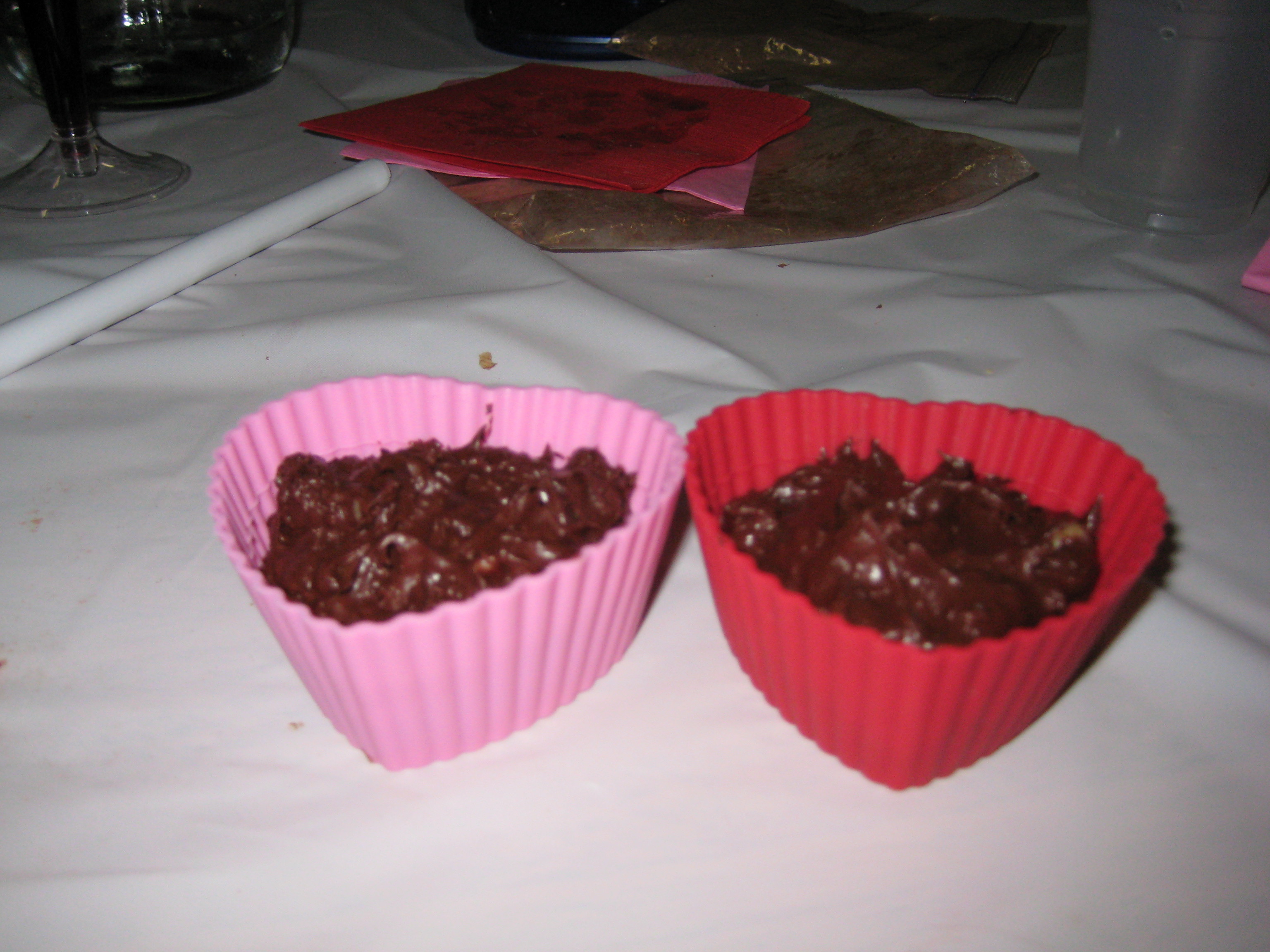
The two pieces of candy above may not look big, but in terms of how rich this fudge is, they are enormous! Between Dave and I we had four, and there are still 2 1/4 sitting in our fridge. They are so good, but not in the addictive, crack-y way a Hershey bar is good. The raw fudge, unlike commercial chocolate, tastes really good. You eat one bite, and are satisfied. It doesn’t impart what Dave and I call the “shovel reflex.” Anyone who has ever eaten half a bag of Hershey’s kisses without realizing it knows what that means! It’s the impulse to keep eating that sugar signals.

Sherri has started a product line of raw cacao ice cream toppings called “Rock-a-Cow” (get it? raw cacao = rock a cow!):
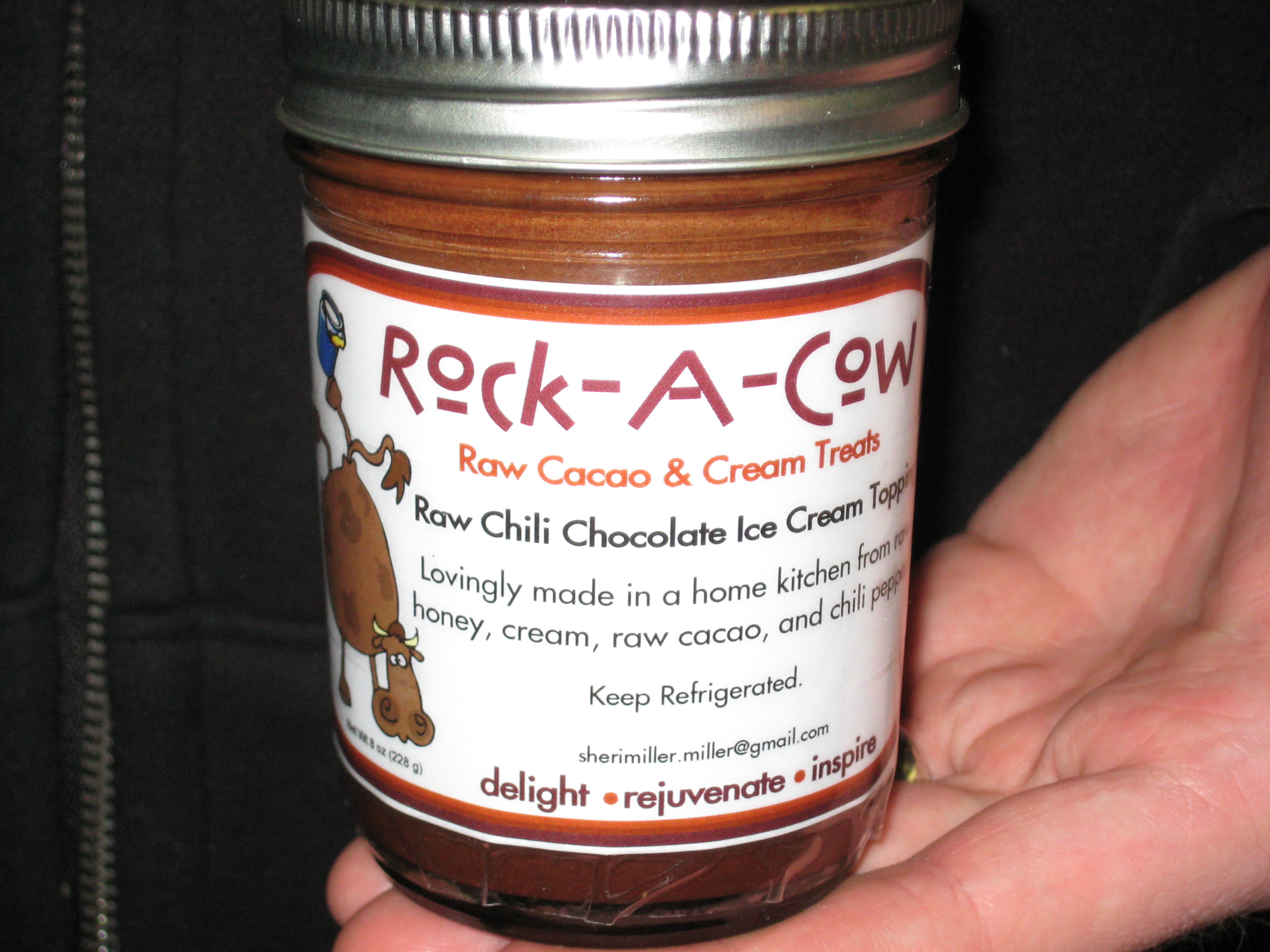
If you are interested in trying some of this delicious dessert topping, or in taking one of Sheri’s healthy dessert classes, she can be reached at sherimiller.miller@gmail.com!

Do Clothes Matter? More Adventures with Body Dismorphia

My husband got a job! Woohoo! (this will be the supplement to his own massage practice). He had a bunch of interviews last week, which means that we had to go shopping on Monday night to get him an interview outfit. It ended up being more of a shopping extravaganza than we expected. My husband very, very rarely shops for clothes. He would like to do it more often, but when it comes down to spending money on clothing or on other things, he will always choose other things. This means that he often lets clothing disintegrate way too much before replacing it. Hence, he was, until Monday night, at a place where almost everything he owned was completely worn and tattered. We ended up getting him 3 shirts, a hoodie, a pair of shoes, and a wool coat. He walked out of the store like he had a new lease on life. After his first interview he told me that for once when he walked into an office, everyone there seemed to respect him. He felt that it had a lot to do with being dressed nicely (I suspect it also had to do with him being a professional in the field that is practiced in that particular office!).

We both need further wardrobe infusion; and we have set aside a bit of our tax return for that purpose. Despite the fact that this runs counter to our attitude throughout our 20’s; at this point in time Dave and I are both convinced that clothing does matter. Both of us have observed enough at this point to have noticed the difference in people’s attitudes towards us when we are dressed nicely. Is it shallow that human beings base so much on physical presentation? Probably. It shouldn’t matter. Can we help our snap judgments based on personal presentation?  Maybe. But I’m leaning towards “no.” Not without some consciousness training. Our brains are wired to pick out traits that denote health and social dominance. In our society, those traits aren’t always inherent to our bodies or minds. They are  often purely ornamental.

I spent most of my 20’s stubbornly refusing to acknowledge that “business casual” is an acceptable requirement for work. My attitude was based on 2 things: 1. clothes don’t actually hold any bearing over a person’s performance of their job, 2. business clothes are expensive, and few people make enough money in their 20’s to afford work clothes AND casual clothes. I still think that both items are true. However, I now know how it can hold a person back in their career to show up to work looking less-than-polished. People will judge you; whether they mean to or not.

The paradoxical thing about my attitude at the time is that I did actually really like clothes. I had a personal style, it was just much more casual than what was appropriate for work. So, I did actually care about my appearance. Just not at the office. I like clothes because of personal expression. Dressing oneself can be a pretty creative act. It can be a lot of fun, and can have a  profound effect on they way we see ourselves. I still love looking at clothes…on other people, that is. I fear that I have lost any zeal for actually dressing myself.

Sometime around the age of 23 I recall having a conversation with a friend that included the phrase: “please don’t ever let me go out in public wearing sweats.” Fast forward 7 years, to my frequent uniform: yoga pants and a tee-shirt. This decade’s sweats equivalent. Furthermore, most of my work clothes are ill-fitting and/or really old. Most of my casual outfits consist of jeans, a tee-shirt, a hoodie, and tennis shoes. When I have to go out for social events I panic about what I’m going to wear. I know that I would feel a lot better about myself if I liked what I was wearing. Sadly, I have realized that I have lost most of the sense of personal style that I once had.

Shopping now is kind of a wilderness experience for me. I feel lost. I feel uninspired. I feel frustrated. I have had very little luck during recent shopping trips. I just haven’t been able to find anything that I like that also looks decent on me. Part of me feels like the problem is that I have never adjusted my personal style to the change in my body size. I still like clothing that really only looks good on women who are smaller than I am. This could be somewhat true. There are some things that are exclusively for the size 8 and under. However, I often see outfits on women who are my size, or larger, that look really cute, and would totally fit under the category of “things I like.” This leads me to suspect that part of the problem is that, once again, I am not seeing what is really there when I look in the mirror.

So, what do I do? I guess that I’m just going to have to take what I know intellectually about shapes and colors that flatter me (the “shapes” bit is mostly stuff that I’ve picked up from What Not to Wear. Hey, it’s instructional!). And buy things based on actual fit instead of on what I see. This could be kind of tricky! But I’m going to have to go for it.

What do you have a personal philosophy on clothing? Do you think it matters?

Creating a Life

Lately I’ve been focusing a lot on food and health on this blog, but that is not the only fish I’ve got to fry! What of my art goals for 2010? Well, I have not resumed The Artist’s Way. I have not joined a writer’s group, and I have not started guitar lessons (yet). However, I don’t feel like I’m suffering for lack of creative outlets.

I haven’t started doing the creative endeavors that I set out to do this year because I’ve been pretty busy. I’ve been busy in a good way. For one thing, I have been doing a lot of editing lately. As David has been working on getting marketing materials together for his massage practice, and cover letters together for job applications, I’ve been busy helping him to craft messages that are good representations of him and what he believes in. I’ve also been asked to look at several cover letters for friends recently, which is fun for me. Editing is something that I’m good at, and it feels good to use something I’m good at to help people out. Many people may not realize that editing is actually quite creative. It’s a real creative challenge to take something that somebody else has written and tweak it to suit his or her audience while still retaining his or her “voice.”

Editing aside, I have also been learning HTML. The main reason that I set out to learn it is for career development. Many writing positions are now web-based. Even though I already know how to use several web editors, most web-based positions require at least a basic HTML knowledge. The second reason for learning it is that I am slowly but surely building a (very basic) website for David’s practice. I know that there are a lot of cheap services that we could use to create a website for him; we may still use one of them to build something fancier. But right now it’s good for me to have a specific project as I’m learning. It helps reinforce the knowledge. I have been finding the project very inspiring.

I haven’t put a whole lot of action into creating a career path for myself recently. At least not directly (above and beyond HTML!). But I have been working on it; at the very least I’ve been working on it at an emotional and intellectual level. This kind of thing takes a lot of thought; a lot of working through issues that I didn’t know I had. It takes up a lot of head space.

Another piece of the puzzle is trying to whip my body back into shape. I won’t hover on this topic very much right now, since I already do a lot of that on this blog, but attempting to re-create one’s body is actually very creative. So much creativity and interest goes into pouring over recipes, making food choices, designing meal plans, choosing exercise routines, and cooking. It’s much more artistic than I have ever thought it could be.

Finally, though it hasn’t been reflected much yet in the consistency of my posts, this blog has also been enormously inspiring for me. For one thing, it has brought me back to the page. It has got me writing (in public – yikes!) after a long absense of the will to write. It has me feeling exploratory, and really thinking about what it is that I want to write. There are trillions of topics to pursue, and just simply writing about my own journey through “getting my act together” has really been helping me to figure out what my secondary passions (after words) are.

I feel fulfilled right now, with the creative end of my life. It’s a new revelation that simply creating my life can fulfill that creative urge within me. Therefore, I’m not going to come down too hard on myself for not hitting the specific goals that I set out for myself a month ago. I am excited to move on to learning new things, and creating new things. But right now my life seems pretty full!

Inner Guidance

Yesterday was an emotionally challenging day for me. The cause was nothing really specific. It was just a combination of a bunch of things: my alarm didn’t go off, and I overslept. It was rainy and gray outside. I paid my bills (never fun), and realized that the new outfit I was hoping to buy for going out this weekend (more on that later) wasn’t going to happen. People keep asking me questions about a transition that is happening in my job; I don’t know the answers, and I feel anxious about it. David is looking for a job, which is gnarly business for anyone, but particularly for someone like him who has never really had to learn how to look for one. It stresses me out, too. And the walls are starting to really close in on us at home. Five adults and two large dogs make for a pretty crowded house. I felt bummed out for all of yesterday afternoon, and into the evening. I almost didn’t work out. But then I did. And I felt better.

I didn’t get enough sleep last night, and I woke up feeling bummed out again this morning. I drove to the bus depot feeling bummed out. On the bus, I wasn’t going to read because I didn’t feel like it. But then I did. And I felt better. I was reading a passage in Reinventing the Body, Resurrecting the Soul by Deepak Chopra. It was about the inner guidance that we humans have. Intuition, instinct, or soul – whatever you want to call it; I think it exists. I’ve seen many examples of it in my life. The funny thing about this inner guidance is that life is so much easier when you follow it, but people so rarely do. I’m no exception. The less you listen to it, the quieter it gets. The more you listen to it, the more it seeps out into the physical world and starts giving you direct signs of which paths you should be taking.

I think that the main thing that makes it so hard to follow intuition is how deeply rational society has become. I mean, doesn’t what I described above sound a little like schizophrenia? Listening to your “inner voice”? Looking for “signs”? All of us are a little afraid of losing our minds. So we hold on to them like a vice; allowing nothing to come in that doesn’t seem rational. Unfortunately, that vice also keeps positive things, like creativity, from going out. But isn’t it our minds that drive us crazy in the first place? Would we really be so depressed if we could stop thinking about all of the negatives? If we weren’t thinking of all the negatives, would we be spending that energy on doing the positive?  Maybe losing a little bit of our minds isn’t such a bad thing.

So, letting go of a bit of my mind, being irrational, I’ve been reflecting this morning on the times in my life when everything just fell into place. When I chose my college. When I met my husband. When I quit a bad job. When we were planning our wedding. I’ve also been thinking of the times when my intuition, and all the signs, pointed to one thing; but I did the rational thing instead, and ended up losing. When I stopped writing. When I went to school for Arts Admin. It doesn’t always have to be a major decision. Your intuition could point you to turn left instead of right, and it could end up making a huge difference in your life.

In the last year, I have made some rational decisions that also felt intuitively correct. Encouraging David to quit his job at his family business and follow his intuition to be a healer. Moving back in with my family. These are not decisions of the variety where everything falls easily into place. These are decisions of the variety that take patience. But there have been signposts along the way that have told me that I did the right thing. If I can keep my awareness open for more, and not get dragged down by negative thoughts, it’s going to get easier. The more open I am to positive change, the more opportunities I’m going to see for it.

When was the last time that everything just fell into place for you? Was it obvious? Were you open to it? Or did it seem crazy?

The Connection

gala

Abby, Shannon, and me at the Gala, 11/2009

Over the last week I have been thinking a lot about how connected all of my big goals are with each other. Good health, strong spirituality, wealth, and a satisfying career are nodes on the same loop.

Good health is biggie. We’ve all heard the phrase “you haven’t got anything if you haven’t got your health.” This is true on so many levels. The first level is obvious: if you are sick in any way, you are not able to function to your highest potential. If you are tired, can’t breathe, are in pain, can’t move properly, etc., it is going to make it all the harder to reach any goal you set out for yourself. Obviously, people overcome all kinds of physical obstacles to achieve their dreams; but at this point in time I feel like if I have any control over the obstacles, it’s best to just remove them. I have enough “issues” to get over without adding physical problems to the pile! The more energy I have, the more I can devote to spirituality, career development, and wealth.

The second level is that physical issues feed into the psychological issues. If you don’t feel good, it affects your brain chemistry and how you perceive the world; which then affects your behaviors, which affect how others perceive you. The perception of others can affect a lot of things – from your personal relationships to your career. It’s all a self-fulfilling loop. Feeling bad begets feeling bad.

The next level is that your health affects your appearance, which also affects the perception of others. Let’s face it, as much as we all want to say appearance doesn’t matter, it absolutely does. Despite our advanced self-awareness and cognitive ability, it’s my opinion (based on some stuff that I have read that I am too lazy to go find for reference!) that humans still have some holdovers from “survival of the fittest.” Above and beyond obvious conscious biases (ie., if you look like a supermodel or an olympic athlete, chances are that people might be “drawn” to you!), if you’re not healthy, there are a million little subconscious ways that other people are going to know it and be subconsciously biased towards you. I think that is some of the basis for “gut feelings” about people. If you have the opportunity to remove biases that others might have towards you, it is only going to be helpful in developing the relationships that a person needs for a successful career, etc. In other words, I think that health touches every part of our lives.

The next part of the “loop” is money. I don’t think that a lot of money is necessary for good health. But I do see where the more money a person has, the more they can afford to spend on maintaining their health, and they will definitely be less stressed out without debt nagging at them. Furthermore, there’s the old adage, “it takes money to make money,” you need to spend money on education and/or on other resources and supplies in order to gain a successful career that will earn more money. More money can also mean more free time- which can lead to more time for spiritual practice.

Next we have career development. Having a fulfilling career leads to a better sense of confidence and well-being, which contributes to good health in all kinds of ways – higher levels of endorphins, lower levels of stress, etc. People tend to be more successful at things they are passionate about. Success leads to wealth. I also believe that having a vocation, or doing what you are “supposed” to do for a living, can be part of a spiritual path.

Finally, there is spirituality. Like health, I feel that spirituality touches every single part of our lives. Part of it is that I believe that we are each active participants in creating our own realities. Every thought that we have has the potential to be a “prayer”- we are constantly asking the universe, or God, or whatever your preferred title, for what we want via our thoughts and intentions. If you think negatively about your health, money, or career, your experience is going to be negative. If you think positively your experience will be positive. I believe in this both psychologically and physically (I put weight on the whole theory that thoughts have physical bearing). The more energy I can devote to training myself to live with intention, and gratitude for the life that I have at any given moment, the better off I feel that I will be.

So really, the main point that I am trying to make is that having a lot of goals doesn’t need to be overwhelming, because if you are working hard on one of them, it is also going to make a gain in the others. Everything is a big web, and when you make positive changes in one area of life, all areas will be positively affected. Personally, I feel really good about focusing most of my energy on good health right now. It seems like a strong cornerstone. But it’s been a nice side-effect of that focus to begin noticing other, seemingly unrelated changes!

Letting Go

Colors

©2007, Chaos to Clarity

I have been stuck on Week 3 in the Artist’s Way for two months. Sad, but true. I have still been intermittently writing my pages and going on Artist Dates; but I haven’t really been sticking with the program; doing the exercises, etc. The biggest reason that people give for falling out of the Artist’s Way is that it is so time consuming. This is true. It does take quite a bit of time; at least an hour per day. I think that the other reason that people fall out of it is that it requires you to dig in and touch places that you might not want to touch. In fact, it requires you to poke those places especially hard, because they could be the places that are most likely keeping you blocked. It feels easier to walk away from the path that you know you should be on than it does to to face the things that are keeping you off from it. However, it doesn’t make much sense to embrace a lifetime of anxiety because you aren’t doing what you are meant to do in favor of temporary relief.

The first three weeks of the program have a lot to do with letting go of impediments, whether it is letting go of your inner critic/editor, or letting go of toxic relationships with other people. I made it through the first two chapters with flying colors, and took the major step of going public with this blog. I did that even though I was terrified to show my writing to anyone. The way I look at the world has changed a lot from just those two weeks. However, Week 3 is something that I clearly have a problem with. It is called “Recovering a Sense of Power.”

The hard thing about chapter 3 is that to recover a sense of power, you also need to take responsibility. You need to look at what you are doing that robs you of a sense of control over your own destiny, and at what other people in your life are doing to do the same. I think that the reason that I have been stuck here is that I have a problem with letting go. Of anything. I am a pack-rat, both physically and emotionally. I am a big fan of shrouds and safety blankets. I like, to a certain extent, security. This means that I have trouble letting go of anything that I once hid behind, particularly images. This is what makes it hard for me to completely let go of smoking. I have trouble letting go of anything that can be an excuse; like being fat, or being too “busy,” for example. I have trouble letting go of anything that has been in my life for a long time; like toxic relationships. All of these years I have thought that I have no will power. No strength. The truth is that I have extreme tenacity and an unusually strong will, but that I have been using those character attributes against myself rather than for myself. I already have the tools, I just need to work on transforming them.

My guiding question right now is, in the words of a famous hash-smoking caterpillar, “whoooooo are yooou?” I feel like at this point in time I have a pretty good grasp on who I am at my core.  The exercises in Chapter 3 have helped me find that person even more. Now I  need to work on becoming that person outwardly, and to do that I need to hold on to her, and let go of the other things that are trying to destroy her. When I can do that, I will know that my sense of power is recovered. The thought of feeling really in control of my own destiny has been creeping in for me, and is really exciting, rather than terrifying as it has been in the past. I plan to finish my Chapter 3 exercises and do my artist date tonight and tomorrow. It will feel good to finally charge forward again!

The Doors of Perception

Lately I have been pondering perception. I’ve been wondering how much misery is created in this world by our perceptions of situations, rather than by the facts. It has caused me to look back on my life and wonder how many of the situations that have been painful for me were at least half in my head. I’m thinking specifically of situations in which I felt victimized by other people.

One of the things that got me thinking about this was, oddly enough, an episode of 30 Rock. I tried to find some clips from the episode, but was unsuccessful. I will try to just sum it up: in the episode Jack talks Liz into attending her high school reunion. Liz doesn’t want to go because in her mind she was tortured and ostracized by her classmates. There is a flashback scene that shows her defending herself against the cruel teasing of her classmates. When she gets to the reunion, she discovers that her classmates viewed her as the cruel one, always being defensively mean in response to their friendly advances. The same flashback is shown from the perspective of her classmates, in which Liz, rather than defending herself from their cruel teasing, is cruelly lashing out at them. I remember seeing that episode and wondering; “huh, I wonder how much of that was true for me”?

As I’ve mentioned before, I was extremely shy for most of my childhood/early adulthood. I spent a lot of that time bemoaning the fact that the only attention that people seemed to pay me was to make fun of me. In hindsight I wonder if I didn’t kind of invite that. The problem with being shy is that people often perceive you as being stuck up – they think you don’t talk much because you think you’re superior somehow, when it is really the opposite. I know that I spent most of my time frowning and looking unapproachable (which is so strange to me now, because for years now people have told me the exact opposite – that it’s my smile that makes me seem so approachable!). Also, in hindsight, I responded defensively to pretty much everything. I was so convinced that most people were out to hurt me that I’m pretty sure I was inappropriately rude to people sometimes.  I spent a lot of time hiding behind my hair rather than engaging with people. I lived in a constant state of embarrassment and defensiveness.

I’m not saying that there aren’t some people who are just cruel for no reason. What I am saying is that when you feel like you are being victimized, it might do some good to check yourself. Perception in human relationships can be a big viscous cycle. First off, sometimes you can’t control how others perceive you. What you can control is how you perceive them. For example, if there is someone that drives you crazy; ask yourself why. Is it because that person is really trying to piss you off, or is it because of that person’s own set of issues, exacerbated by the fact that they sense that you are perceiving them in a negative manner? A little compassion can go a long way. If a person perceives that you are not responding negatively to them, they are less likely to continue negative behaviors, so on and so forth into infinity. In other words, the best way to influence the perception of others is to temper your perception of them. If you try to be understanding of others, it opens a doorway for them to be more receptive and understanding of you.

I still have a little bit of a problem with feeling like people are judging me, and being overly defensive about it. It’s just some of the remnants of a long perception of victimization. The idea of feeling compassion towards people that seem to take jabs at me is another useful life lesson for me (and is, duh, a basic tenet of many of the religions I’ve looked into!). It is something for me to keep in mind while trying to invite patience and positive experiences into my life! It will only make my own experience, and that of people I encounter, better.

Just a Little Patience

You may have noticed that I haven’t posted as much this week as I normally do. This is because I have had kind of a crappy week this week, particularly at work, but also at home. I’ve been overwhelmingly busy for most of the week, and little frustrations have been cropping up all over the place and have been piling up into a big mound of angry-cranky-exhaustion. Things have calmed down, so I’m feeling much better now, and have the presence of mind to notice that a theme is developing. Basically what I’ve realized is, in the immortal words of Axl Rose, I “need a little patience.”

The topic first came up in relation to this post, when my friend Jessica commented that yoga is the only way in which she is patient with herself. To which I say “right on, sister.” I have found that I have good yoga patience as well, though I also tend to be impatient with myself in every other way. The topic came up between she and I again last night, and it got me thinking. First, that people who get impatient for results need to just keep working. Keep plodding onward. This is because if you keep working, it is probable that you’ll get some results sometime, even if they don’t come as quickly as you want them to. Whereas, if you do what I often do and quit working because results aren’t coming fast enough, you will never get any results. Pretty simple, right? Sometimes these big breakthroughs are so easy I could just smack myself for not getting them before!

The next thing that I got to thinking in relation to patience is that maybe I am not just impatient with myself. I’ve written before about how bottled anger is one of my personal roadblocks in life. In the last year I’ve realized that a lot of that anger has been due to living too much of my life based on other people’s ideas for me. In the past year I’ve made a lot of progress on taking back my life from the constructs that were built for me when I was a kid. It has done A LOT for my general well-being. I don’t carry around an internal fountain of hurt and outrage any more. However, I am still prone to flashes of temper that can spoil days at a time. These little tantrums don’t seem based in ongoing adversity like they used to be. They’re not pity parties. Since I was thinking about patience anyhow, I thought , “huh, maybe a big chunk of anger in my life has to do with a general lack of patience.” Hmmm…let’s examine this.

I thought about all the things that pissed me off in the last week; the things that made this a bad week. Lo and behold, all items had to do with impatience, mostly impatience with other people’s quirks. Don’t get me wrong; I think there’s a fine line of respect that people need to walk when working together or co-creating anything in this world, whether it’s a project for work, or a lifetime together. Everyone has their own style, and partnerships of any kind move along more smoothly when each person respects the other one’s style. However, there are also some resources involved that each person brings to the table. Time, money, energy, etc. One needs to have respect for the other person’s resources as well. Respect for style and respect for resources needs to be balanced, and all players need to contribute to that balance.

I’ve been realizing this week that maybe my scale for this type of balance is a little wonky. There are some situations where I think annoyance, AKA impatience, is valid. When a person’s personal style is quickly draining my resources, usually time, that person is not respecting me. In that case, the imbalance is on them. I am thinking here about projects that take twice as long as they should due to some lack of skill on another person’s part. In those cases, if my partner is not acknowledging the problem, it’s probably more constructive for me to do the hard thing and point it out to them than it is to just be passive aggressive and get pissed off. That way we can make a plan to compensate for it in the future. Or, I can acknowledge that the person’s style is just different than mine and set limitations; such as, “I can spend this much time on this;” and then stick to it.

On the other had, I know that I also need to be more reasonable about what is an actual drain on my resources. For example, my personal expectations aren’t necessarily the same as a deadline. If I ask my husband to do a load of laundry, just to get it done, it’s not the end of the world if, for some reason, he doesn’t do it right away. This is not a valid reason for me to get pissed off; if I do, I’m just irritated about his general way of doing things. It’s not cool to get mad at people just because they don’t do things how I would do them. However, if I say “Honey, can you please do this, it needs to get done by this time for this reason,” and it still doesn’t happen, that is probably a valid reason to get annoyed (unless there was a really good reason why he couldn’t do it). In either case, I’ve been realizing that even if it seems like an issue is primarily the other person’s fault, there are always things that I can do to avoid frustration. My first response shouldn’t always be to get angry.

So, in short, patience is a virtue that does not come naturally to me. It’s just one more thing that I need to keep noticing and working on in order to clear up more space in my being for the good stuff in life!

Can Yoga Help Fix My Brain?

Many moons ago, one of my best friends and I attempted to take a Yoga class together. We were both 24 at the time, and we were both pretty hyperactive. Neither of us was able to gather up the focus needed to really get into it. We would goof off through the whole class, and then we’d both infallibly fall asleep during the closing meditation. Both of us decided after our 10 sessions that we were not the Yoga types. My friend and I both remain fairly high-energy, but have mellowed out quite a bit in our “old age.” Both of us have grown in our ability to focus. She practices T’ai Chi. I have tried that (my husband loves it, and has been in touch on and off with a master since he was 16), but it really wasn’t my cup of tea (that pun was intended – if you know how much tea is drank in conjunction with T’ai Chi!).

In recent years I have been feeling a pull again towards yoga. I’ve had little tastes of it when I’ve been in belly dance classes (my attempts to learn belly dance keep getting thwarted – first by my grad school class schedule, and then by breaking my ankle). It seemed like maybe I might like it now that I’m more of a grown-up. Two things sealed the deal on trying it again: 1. David has been doing it as part of his coursework for school, and has been encouraging me to take it up as something we could practice together, 2. Another dear friend of mine mentioned to me, while I was in the middle of a meltdown, that yoga has played a key role in helping her to love her body. She said that she loves it because it helps her to be more “in” her body, and builds the mind-body connection.

My mind-body connection is broken. Well, maybe not broken in the sense that it doesn’t exist, but it is sick in a way that has to be hurting my attempts to get healthier. I have mentioned a couple of times on this blog that I have been through treatment for eating disorders. Part of what causes eating disorders is body dysmorphia. This means that when you look in the mirror, you don’t see what is really there. You see yourself as being distorted somehow – too fat, too ugly, etc. Here’s the description from MayoClinic.com:

Body dysmorphic disorder is a type of chronic mental illness in which you can’t stop thinking about a flaw with your appearance — a flaw either that is minor or that you imagine. But to you, your appearance seems so shameful and distressing that you don’t want to be seen by anyone. Body dysmorphic disorder has sometimes been called “imagined ugliness.”

For info on causes, go here.

As stated above, body dysmorphic is a chronic disorder. The behaviors surrounding it can be cured, but the disorder itself is ongoing (though it can go into remission!). Therefore, one needs to learn good self-care and coping mechanisms. Some doctors want to try to treat this with meds. I disagree with that approach, particularly because there aren’t any medications that are approved for specifically treating this disorder. What you’re actually treating is the related depression, anxiety, etc. I’m not necessarily depressed or anxious in a clinical sense, so I think that behavioral therapy is the way to go. Obviously I learned how to stop starvation and purge behaviors. I’m still working on the binge part; but that is getting progressively better. Otherwise, I am doing a pretty good job on the physically self-destructive behaviors front.

The more internal symptoms are the hard part. Especially since I actually am on the heavier side at the moment. Here is a list of symptoms, hand-picked from MayoClinic.com, that I struggle with:

  • Preoccupation with your physical appearance
  • Strong belief that you have an abnormality or defect in your appearance that makes you ugly
  • Frequently examining yourself in the mirror or, conversely, avoiding mirrors altogether (I avoid)
  • Believing that others take special notice of your appearance in a negative way
  • Feeling extremely self-conscious
  • Refusing to appear in pictures (I don’t mind this if I am not overweight. If I am, I will still do it, but it makes me feel miserable)
  • Comparing your appearance with that of others (the funny part about this is that though I am very hard on myself, most other people look lovely to me. Therefore, inside my brain, almost everyone is better looking than I am)
  • Avoiding social situations (only when I’m heavy. If I am, I will try to avoid situations where we are going “out,” or where there are a lot of people I don’t know).
  • Wearing excessive makeup or clothing to camouflage perceived flaws (I have relaxed on this front. I will now go some places without makeup on, but for a long time, even though I don’t wear a lot of makeup, I wouldn’t leave the house without the minimal amount I do wear).

These symptoms all appear as minor behaviors that other people may or may not notice.  The bigger part is inside my head. I know rationally that all of these things are extremely self-centered and/or untrue. However, the whole reason that it is a disorder is because it is irrational. These symptoms, at certain times, will keep me from doing things that I love to do.

When my friend mentioned yoga to me as a form of body-love, I was crying because I didn’t want to go out dancing. I didn’t want to go because I was embarrassed of my body. Usually I can hide the real reason that I don’t want to go, but she had kept pressing me about it until I had to be honest. I LOVE to dance. But at the moment it is hard for me to do it. Obviously I am getting more and more comfortable with being honest about what’s going on in my head. I attribute this to being less and less lazy about self-care.  Meditation  helps a lot to re-program my thinking-keeps out the automatic negative thoughts (ANTS). Exercise helps a lot with endorphins and just getting rid of energy that I might use against myself. Massage helps dissolve issues with being seen.

On Monday night I finally started a yoga class. I have practiced it every day this week, and I already know that I love it. I am looking into doing another weekly class. It is so good; it is so good because it is something that I feel good doing right now. Not when I am thinner or in better shape. I don’t feel self conscious or judged in the studio, which I think must have something to do with the spiritual aspect of yoga. I don’t think when I’m doing it, I just feel. It is the first thing that I have done that feels like it is addressing all of my broken pieces at once.

Anyhow, if you are a person that has body image issues, and aren’t already doing yoga, I highly recommend starting!

Life or Death; You Decide

David’s grandmother passed away last week, and was laid to rest on Saturday. I didn’t know her very well because she was a victim of Alzheimer’s, and it was fairly advanced by the time David and I started dating. Despite not really knowing her, I cried through the entire funeral service. The first reason is that I cry almost any time I see someone I love crying; and I have the insane good luck of not only loving my husband deeply, but also loving his whole extended family. I’m a big empathetic crier. Also, any time that I read or listen to the story of someone’s life, I can’t help but put myself in that person’s place. In the case of David’s grandma, she did a really good job at life. She was someone who lived life with grace and joy despite an abundance of adversity. I didn’t cry because it was sad that she had adversity in her life; I cried because I was happy that she was still so happy. I wish I had felt the same thing at all of the funerals I’ve attended.

Adversity in life is something that I have been thinking about a lot lately. It’s been on my mind because my family is one of the many families that has been hit very hard by the economic problems in this country. With five adults (my parents, my brother, my husband and myself) living under one roof, and with each of us having our own fully-developed and separate problems, the house is a veritable petri dish for the many ways that people deal with adversity. I’ve been closely observing everyone’s different responses in my family and outside of it. There are almost as many difficult circumstances and ways of dealing with them as there are different people in the world, but I think that they can all be simplified into two sources and two ways of responding. The following is what I have observed so far.

I think there are two basic sources of adversity. The first source are things that people can’t help, and had no part in bringing on themselves. Things that just “happen” to people that have nothing to do with their choices. Some examples are disease, floods, child abuse, tornadoes, and other disasters. Cases in which the victims are completely innocent. Some might put the economic downturn in this category. The other source is based in human choice. For example, I chose to go to college for writing, even though I knew it would make it harder for me to make money. I guess you could call this category the category of difficult decisions: you weigh the pros and cons of a decision and decide what you think is best, and sometimes you end up being wrong.

Sometimes the line between the two categories is blurred. Often people will do everything they can to be sure that an event is whittled down to the finest point of fault. After hurricane Katrina, for example, a lot of people said those people somehow deserved what happened because they chose to live in a city that is at risk for flooding. This whittling becomes especially true when you bring God into the discussion. People don’t want to think about the possibility that God would just let something like that happen, so they find ways to make disasters the fault of the victims. More often it’s the other way around, where people don’t want to accept responsibility for their problems, and play the victim of a tyrannical God when a problem is really the result of their own poor choices.

One thing that is universally true about adversity is that everybody has it (and if you can’t see someone’s problems it just means that they’re really good at hiding them). A second thing that is almost as true is that the severity of each person’s problems are completely in the context of that person. For example, when we hear celebrities whining to the press we all harden our hearts, because we think “yeah, right. I would LOVE to trade my problems for her problems!.” But if the worst thing that ever happens to that celebrity is that she gets her picture taken too much, it is going to feel just as bad for that person as it would feel for the average joe to lose his house. We can’t really compare our problems to anyone else’s, because no two people are the same inside their heads and in terms of what they are emotionally equipped to handle.

Like I implied in my opening paragraph about David’s grandma: some people respond to adversity as a fact of life. They might be sad for a little while, or mad, but they deal with it and move on. Others respond as if they are always a victim. In other words, they get angry about the problems life presents, no matter how huge or how minor, and then never even try to get over it. And what is the point of staying angry? It does nothing but destroy a person’s ability to see the ways that they are blessed. I think that these two ways of responding represent two basic ways of viewing life: you can either view it as a trial or a gift. A blessing or a curse. And I’ve been learning that so much depends on choice.

It isn’t always easy; especially when I feel like life is throwing curve-balls at my head on a daily basis, and I still have my fair share of days where I don’t want to get out of bed; but I have been trying to choose the perspective of life as a gift. The way I see it is that no matter what happens, no matter how bad things suck, I still have this life, and I try to be grateful for it. I could have never been alive at all. I don’t want to waste my time on this amazing planet being angry all the time about things that I couldn’t help, or about times that I made the wrong choice. It’s a gift to have the capacity to make any choice at all. I have to say, the more I can bring myself to think this way, the less big problems seem, and the more happy and alive I feel.